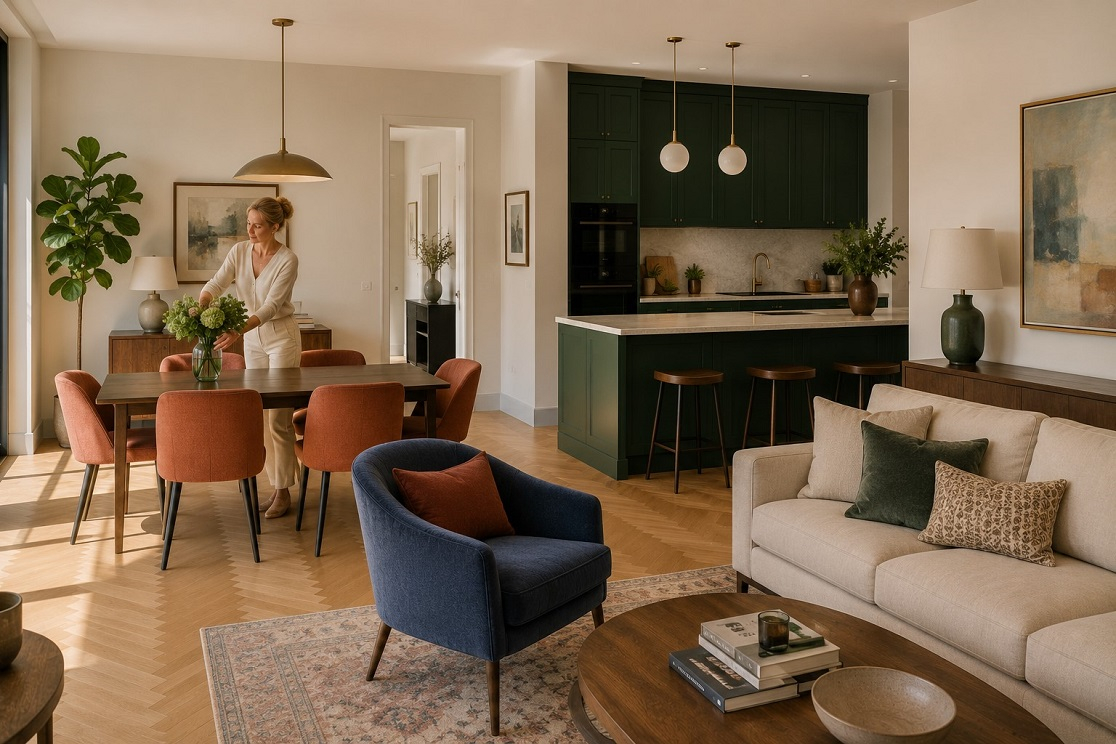
White walls, grey kitchens and beige living rooms have become familiar features in renovated homes.
There are practical reasons for choosing them. Neutral shades are easy to combine with different furniture, rarely dominate a room and can make a property easier to present to a broad range of buyers or tenants. Colour, however, is beginning to appear more confidently in kitchens, studies, bedrooms and living spaces.
“For a long time, many clients regarded white, grey and beige as the safest possible choices,” said Alex Markus, Chief Executive of City-Lets Ltd. “Those colours still work extremely well, but people are becoming more comfortable adding character to selected parts of the home.”
Neutral Colours Are Becoming the Background
Introducing colour does not mean abandoning neutral interiors.
In many homes, white, cream, timber and soft natural shades still provide the foundation. The difference is that colour can then be introduced through cabinetry, furniture, artwork, tiles or one carefully selected wall.
“Neutral colours are often most useful as a backdrop,” Markus explained. “They give you flexibility, but that does not mean every surface needs to be the same shade.”
This approach allows a room to retain a calm appearance while avoiding the sense that every part of the home has been decorated identically.
One Change Can Alter the Whole Room
Clients sometimes assume that making an interior more colourful requires repainting the entire property.
It rarely does.
A kitchen island, bookcase, armchair, wall behind a bed or set of dining chairs can introduce enough colour to change the atmosphere without creating a major decorating project.
“The mistake is thinking the whole home needs to change at once,” Markus said. “Sometimes one painted cabinet, one wall or a different piece of furniture is enough to give the room a clearer identity.”
These smaller changes are also easier to reverse or update than permanent structural work.
Colour Can Make a Property More Memorable
A completely neutral home can photograph cleanly and appeal to a wide audience. It can also be difficult to distinguish from other similarly decorated properties.
That does not mean owners preparing to sell or rent should use strong colours throughout. A single distinctive room or carefully selected feature may be enough to create an impression without limiting the property’s appeal.
“People may view several homes with white walls and similar flooring on the same day,” Markus said. “A dark green study, coloured kitchen cabinets or an interesting tiled bathroom can give them something specific to remember.”
The goal is not to make the decoration overpower the property. It is to prevent every room from feeling interchangeable.
Colour Can Help Define Open Spaces
In apartments where the kitchen, dining area and living room share one space, each part of the room can begin to blend into the next.
Colour can provide separation without changing the floor plan.
“We often advise clients that they do not necessarily need another wall,” Markus said. “Changing the kitchen cabinetry or painting the wall behind the dining table can be enough to make the different areas feel more clearly defined.”
Furniture, rugs and lighting can serve the same purpose, allowing the room to remain open while giving each area a recognisable function.
Smaller Rooms Offer More Freedom
Many homeowners are understandably cautious about using a strong colour in the main living room or kitchen.
A hallway, guest bedroom, study or small bathroom often offers more freedom. Because these rooms are smaller or used for shorter periods, a deeper shade can add character without shaping the atmosphere of the entire home.
“Smaller spaces are often good places to experiment,” Markus said. “You can introduce a stronger colour in one room while keeping the main living areas much more restrained.”
It also allows homeowners to see how comfortable they are with colour before making larger changes elsewhere.
Older and Newer Pieces Can Work Together
Adding personality does not require replacing every item with a matching set.
Timber furniture, older pieces, artwork and coloured fabrics can sit comfortably alongside newer kitchens, flooring and lighting. In some homes, that mixture creates a more natural result than furnishing every room from the same collection.
“Some clients assume everything needs to match,” Markus said. “Usually it is more important that the individual pieces work together. An older table or a stronger colour can add warmth without making the room feel untidy.”
The strongest interiors are not necessarily the most expensive. They are often the ones where each choice feels deliberate.
Balance Still Matters
Colour can improve a room, but too many competing shades can make a property feel smaller or visually unsettled.
For sellers and landlords especially, restraint remains important. Strong permanent finishes may appeal to one person while discouraging another, so colour is often safer when introduced through elements that can be changed relatively easily.
“The aim is not to make every room bold,” Markus said. “It is to decide where colour adds something and where a neutral finish remains the better choice.”
Colour is not replacing neutral design. It is being used alongside it, giving homeowners another way to make individual rooms feel warmer, clearer and less anonymous.