
Budapest has become one of Central Europe’s most attractive residential investment markets. Over the past decade, international investors have increasingly entered the city’s property market, drawn by relatively affordable real estate, strong rental demand, and growing economic activity.
As the market has matured, professional property management has become an essential part of operating rental properties effectively particularly for landlords who live outside Hungary.
Yet one question remains central for many investors:
How much does property management cost in Budapest?
While pricing varies between agencies, most professional property managers follow a similar structure consisting of:
- a monthly management fee
- a tenant placement (leasing) fee
- occasional maintenance coordination charges
Understanding how these fees work and what services they include helps landlords evaluate whether professional management is the right choice for their investment.
This guide explains how property management fees work in Budapest, how they compare internationally, and what landlords should expect when hiring a property manager.
International Investors and the Budapest Rental Market
Budapest’s property market has attracted increasing interest from international investors in recent years.
While foreign buyers represent only around 2–3% of property purchases across Hungary, their presence is much higher in the capital. In Budapest, international buyers account for approximately 12% of property transactions, with demand concentrated in central districts such as District VII, VIII, and XIII.
Several investor groups dominate foreign purchasing activity.
Key international buyer groups
The most active foreign property buyers in Hungary include:
- Germany the largest group of foreign buyers nationally, often purchasing rural properties or holiday homes around Lake Balaton.
- China one of the most active investor groups in the Budapest apartment market.
- Vietnam a major buying group in the capital, frequently acquiring high-value city apartments.
- Romania and Slovakia investors from neighboring countries purchasing both urban and border-region properties.
- Western European buyers including investors from the Netherlands, Switzerland, Israel, and the United Kingdom seeking relatively affordable Central European real estate opportunities.
Because many of these investors live outside Hungary, professional property management services have become increasingly important for operating rental properties efficiently.
Why Budapest Attracts Foreign Property Investors
Several factors contribute to Budapest’s growing popularity among international investors.
Currency advantage
Periods of weakness in the Hungarian forint (HUF) have made Budapest property relatively attractive for investors purchasing with stronger currencies such as the euro or US dollar.
Strong rental demand
Central districts such as V, VI, VII, VIII, IX and XIII remain popular with:
- expatriate professionals
- international students
- employees of multinational companies
This consistent demand supports a stable long-term rental market.
Straightforward ownership rules
European Union citizens can purchase Hungarian property under the same conditions as Hungarian nationals.
Non-EU citizens must obtain local government authorization, but the process is generally straightforward and widely used by international buyers.
Why Property Management Fees Exist
Managing a rental property involves far more than simply collecting rent.
Professional property managers handle the operational and administrative responsibilities required to maintain a tenancy and protect the landlord’s asset.
Typical responsibilities include:
- marketing the property
- organising viewings
- screening tenants
- preparing lease agreements
- collecting rent
- coordinating maintenance
- communicating with tenants
- monitoring property condition
- maintaining financial records
For many landlords particularly those living abroad professional management allows the property to operate as a largely passive investment.
Typical Property Management Fee Structures
Across most mature property markets, property management services follow similar pricing models.
Budapest generally aligns with international standards used in cities such as London, Vienna, Berlin, and Sydney.
Monthly Management Fee
The most common pricing model is a percentage of the monthly rental income.
Globally, property management fees typically range between 8% and 12% of collected rent, with approximately 10% being the most common rate.
This fee covers the ongoing administration and oversight of the tenancy.
Typical services include:
- rent collection and transfer
- tenant communication
- lease administration
- maintenance coordination
- property oversight
- financial reporting
At Citylets, the ongoing management fee equals 10% of the monthly rental income plus 27% VAT.
Tenant Placement (Leasing) Fee
When a property becomes vacant, agencies typically charge a tenant placement fee to cover the cost of finding a new tenant.
This fee generally includes:
- marketing and advertising
- professional listing management
- organising property viewings
- screening tenant applicants
- preparing lease documentation
In most international markets, leasing fees range between 50% and 100% of one month’s rent.
Under the Citylets agency agreement, the tenant placement fee equals one month’s rent plus 27% VAT.
Maintenance Coordination Fees
Property managers also coordinate repairs and maintenance when issues arise.
Typical tasks include:
- sourcing contractors
- organising quotes
- scheduling repairs
- supervising work completion
Under the Citylets management agreement, coordination of third-party repair work is charged at 10% of the contractor invoice value plus VAT.
Example: Typical Property Management Fee Structure
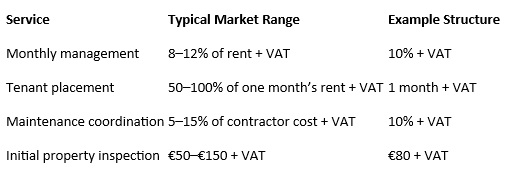
Citylets performs an initial technical inspection costing €80 + VAT before management begins.
Example: Monthly Property Management Cost (Including VAT)
Property management services in Hungary are typically subject to 27% VAT, which landlords should include when evaluating management costs.
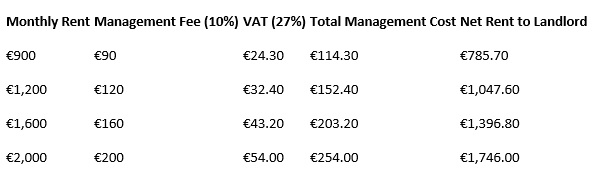
Property management fees are generally tax-deductible expenses, meaning the effective impact on investment returns may be lower than the gross cost.
Example: First-Year Property Management Costs
The first year of management typically includes tenant placement costs.
For a property renting at €1,200 per month, the first-year management expenses could look like this:
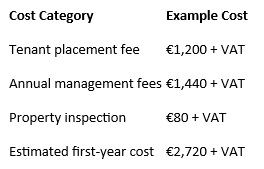
After the first year, landlords usually only pay the monthly management fee if the tenant remains.
What Happens When a Property Is Vacant?
Even when a property is vacant, management companies continue to perform tasks such as:
- marketing the property
- organising viewings
- responding to tenant enquiries
Some agencies charge full management fees during vacancy.
Under the Citylets management contract, the fee during vacancy is €20 + VAT per month.
Investor Example: Rental Yield Before and After Management
Example property
Renovated apartment in District VI
Purchase price: €250,000
Monthly rent: €1,300
Gross rental yield
Annual rent: €1,300 × 12 = €15,600
Gross yield: 6.24%
After management fees
Annual management fee (10%): €1,560
VAT (27%): €421
Total management cost: €1,981
Net rental income: €13,619
Adjusted yield: 5.45%
While management slightly reduces the gross yield, it can also improve performance by:
- reducing vacancy
- improving tenant quality
- maintaining property condition
- simplifying administration
How Budapest Compares to Other Cities
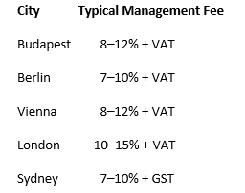
Budapest’s pricing is broadly aligned with international property markets.
Why the Cheapest Property Manager Is Rarely the Best
Selecting a property manager based solely on price can be a costly mistake.
A strong property manager can improve investment performance through:
- better tenant selection
- faster maintenance response
- effective marketing
- regulatory compliance
Even a single avoided vacancy period can offset a full year of management fees.
Property Management as an Investment Tool
For experienced investors, property management is best viewed as an operational expense within a broader investment strategy.
Professional management helps landlords:
- reduce administrative workload
- maintain tenant relationships
- protect property condition
- manage legal requirements
- operate rental properties remotely
For international investors in particular, professional management allows their Budapest property to function as a passive investment asset.
Frequently Asked Questions
What is the average property management fee in Budapest?
Most agencies charge 8–12% of monthly rent plus VAT.
Is VAT included in property management fees?
Property management services in Hungary are typically subject to 27% VAT.
Do property managers charge a leasing fee?
Yes. Tenant placement generally costs one month’s rent plus VAT.
Are property management fees tax deductible?
In most cases, they can be deducted from rental income when calculating taxable profit.
Can landlords manage properties themselves?
Yes, although many investors prefer professional management to reduce workload and risk.
Related Guides for Budapest Property Investors
- Property Management in Budapest: A Complete Guide for Landlords
- Budapest Rental Yield Guide
- Long-Term vs Short-Term Rentals in Budapest
- How to Find Reliable Tenants in Budapest
Author
This guide was prepared by the Citylets Budapest property management team, specialising in residential rental management for international property investors.