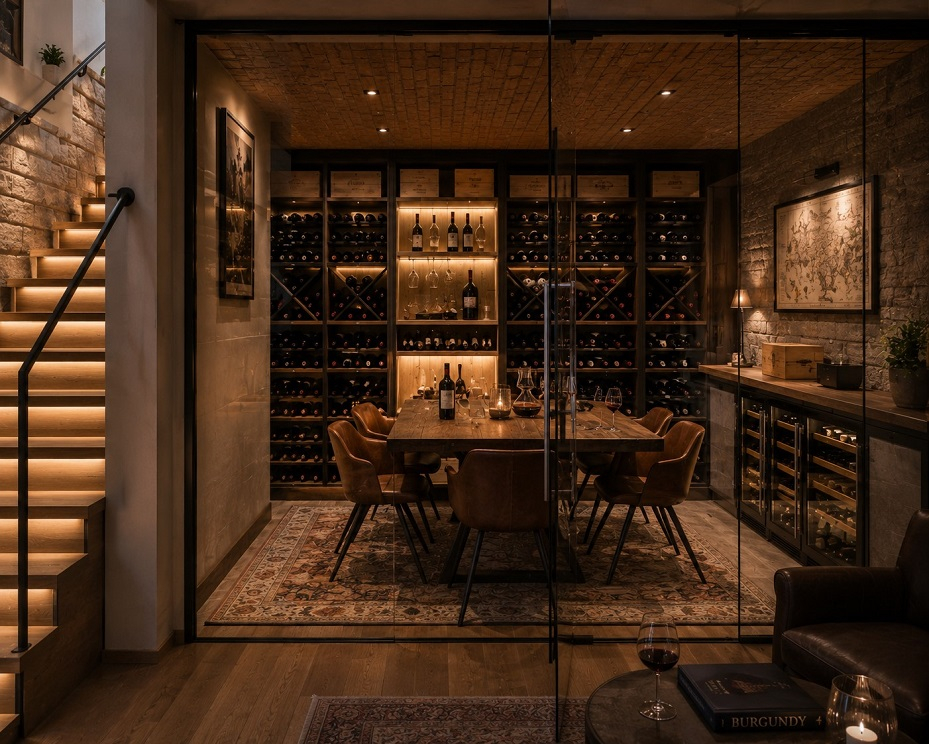
For generations, a wine cellar had a straightforward purpose: age a collection in as close to ideal conditions as possible.
A cool, dark room beneath a house was designed to keep bottles at a stable temperature until they were ready to be enjoyed. Today, many homeowners are thinking about wine cellars differently.
Increasingly, wine cellars are being designed to be seen rather than hidden. Tasting tables, feature lighting, glass displays and dedicated entertaining areas are becoming just as important as storage itself. In much the same way that home offices and wellness spaces have evolved beyond their original function, wine cellars are becoming part of how people experience their homes.
A Wine Cellar Can Be More Than a Storage Room
One of the most memorable examples featured in Hungarian home-design media involved a wine cellar built beneath a kitchen floor.
Hidden below a discreet hatch, the cellar transformed an otherwise unused space into a feature of the home. Rather than storing bottles in a forgotten basement, the collection became part of the living experience itself.
Similar ideas are appearing in homes around the world. Glass-enclosed wine displays, tasting rooms connected to dining areas and climate-controlled cellar spaces are increasingly designed as destinations within the home rather than utility rooms hidden from view.
"The wine cellar used to be somewhere you stored bottles," said Alex Markus, Chief Executive of City-Lets Ltd.
"Increasingly, it's becoming somewhere you spend time. Homeowners are creating spaces where they can enjoy a collection with family and friends rather than simply keeping it out of sight."
Not Every Wine Cellar Is Underground
Traditional underground cellars remain popular because of their naturally stable conditions, but modern homeowners have far more options than they once did.
Some are converting unused basement rooms into dedicated wine spaces. Others are integrating wine storage directly into living areas or dining rooms. Prefabricated underground cellar pods can also be installed in gardens, creating a dedicated wine space without major alterations to the main house.
What's notable is that many of these projects start with existing space rather than new construction.
An underused basement room, a section of a garage or an unused area beneath a house can often provide the foundation for a wine cellar project.
What Does a Home Wine Cellar Cost?
The cost depends largely on the type of cellar being created.
Prefabricated underground cellars typically cost between HUF 2.5 million and HUF 4.5 million, including installation, shelving and ventilation systems. These solutions are popular because they can often be installed much faster than a traditional built cellar.
Traditional brick, stone or concrete wine cellars generally cost around HUF 190,000 to HUF 300,000 per square metre. A typical 20-square-metre cellar may start at approximately HUF 4 million and can easily exceed HUF 6 million once excavation, waterproofing and specialist construction work are included.
Dedicated cellar cooling systems generally range from HUF 150,000 to HUF 500,000 depending on the size of the space and the level of climate control required.
As with many home-improvement projects, the final budget is often shaped by finishes, equipment and design choices as much as the structure itself.
The Best Wine Cellar Fits the Collection
One of the most common misconceptions is that a wine cellar needs to be large.
In reality, the most successful projects are usually designed around how the owner intends to use them.
A compact cellar designed for a carefully selected collection may be more practical than a much larger room that sits mostly empty. Some homeowners only need space for a few dozen bottles, while others may want storage for several hundred.
"The best wine cellars are often the ones that feel personal," Markus said.
"A tasting table, comfortable seating or a display area can sometimes add more enjoyment than simply increasing the number of bottles the room can hold."
A Space Designed to Be Enjoyed
Wine cellars will never be a feature every homeowner wants, just as not every homeowner wants a sauna, gym or home cinema. What makes them interesting is how their role is changing.
A wine cellar was once designed to age a collection. Increasingly, it's being designed to enjoy one.