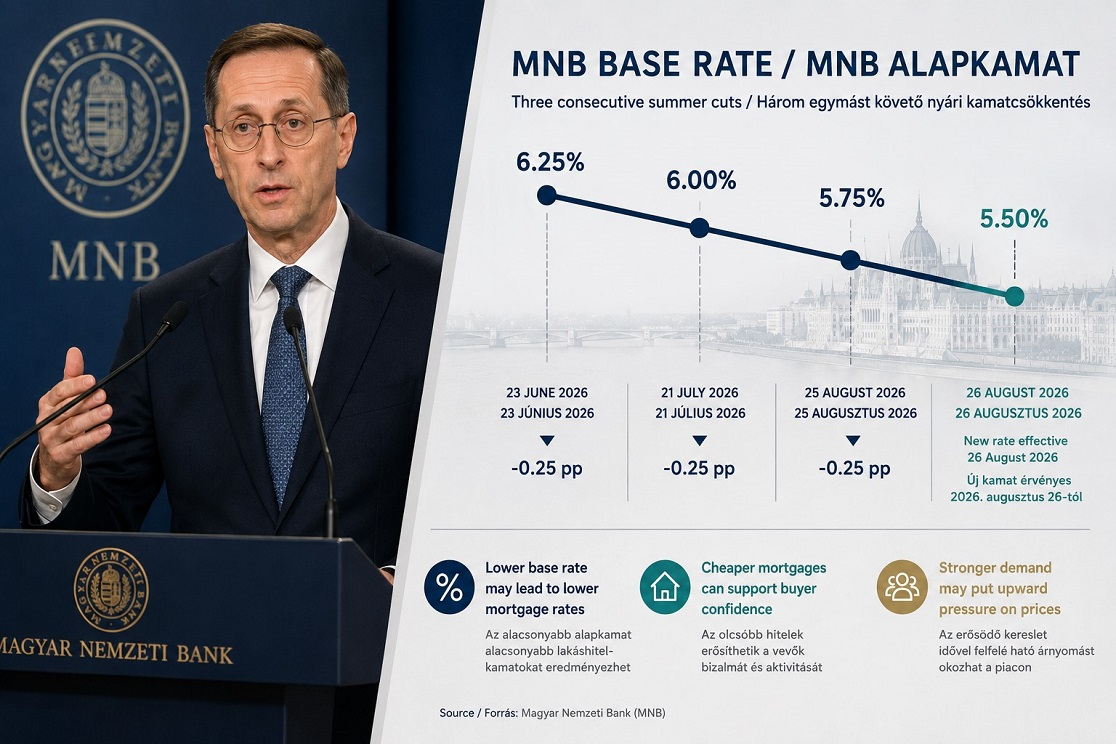
The Magyar Nemzeti Bank has cut its base rate by another 0.25 percentage points, from 5.75% to 5.5%. The MNB has now cut the base rate at each of its three summer rate-setting meetings. For property buyers and owners, the important question is what lower interest rates could eventually mean for mortgages and the housing market.
Mortgage Rates Could Gradually Become Cheaper
An MNB rate cut does not mean banks automatically reduce every mortgage rate by the same amount.
However, if the central bank continues cutting rates and market financing costs fall, banks may be able to offer cheaper new mortgages.
For buyers, that matters because the interest rate affects both monthly repayments and how much they may be able to borrow.
A buyer who cannot afford a particular property at today's mortgage rates may find the numbers work differently if mortgage rates fall.
Lower Rates Could Bring More Buyers Into the Market
Cheaper mortgages can also increase buyer confidence.
Some buyers who have delayed purchasing because financing is expensive may start looking again if they believe borrowing costs are coming down.
More buyers looking for property means more competition for the homes they want to buy. Over time, stronger demand can also put upward pressure on prices, particularly for properties and locations where supply is limited.
“Buyers sometimes wait for interest rates to fall without considering that other buyers are doing exactly the same thing. Cheaper finance can improve what you can afford, but it can also bring more buyers back into the market,” says Alex Markus, Chief Executive, City-Lets Ltd.
Buyers May Change What They Can Afford
Higher mortgage rates do not necessarily stop someone buying a property, but they can change what they buy.
Someone who originally wanted a larger apartment may choose a smaller one. A family looking for a house may consider an apartment instead, while other buyers may move their search from a more expensive Budapest district to a more affordable part of the city or the surrounding agglomeration.
Falling mortgage rates can gradually work in the opposite direction.
If borrowing becomes cheaper, some buyers may be able to increase their budget or reconsider areas and properties that were previously beyond their reach.
The effect may not be the same across every part of the property market. Demand may strengthen first for properties that become affordable to buyers whose borrowing capacity had previously kept them out of that price range.
Investors Could Also Respond
Interest rates matter to property investors as well.
Lower borrowing costs can improve the numbers for investors using a mortgage to purchase a rental property. Falling interest rates can also change the relative attraction of keeping money in interest-bearing investments compared with investing in property.
That does not mean one 0.25 percentage point cut will suddenly bring investors back into the market. The direction of rates over the coming months is more important.
What Happens Next Matters More
The latest inflation figures have also given the MNB more room to reduce rates. Annual inflation fell to 1.2% in July, while core inflation declined to 1.9%.
The next important point will be the September Inflation Report. MNB Governor Mihály Varga said the Monetary Council will use that report when deciding the future path of the base rate.
The central bank expects inflation to remain below its 3% target during the remainder of 2026 and throughout 2027.
For Hungary's property market, therefore, the important development is not simply that the base rate has fallen to 5.5%.
It is whether interest rates continue falling, whether banks respond with cheaper mortgages and whether that encourages more buyers back into the market.