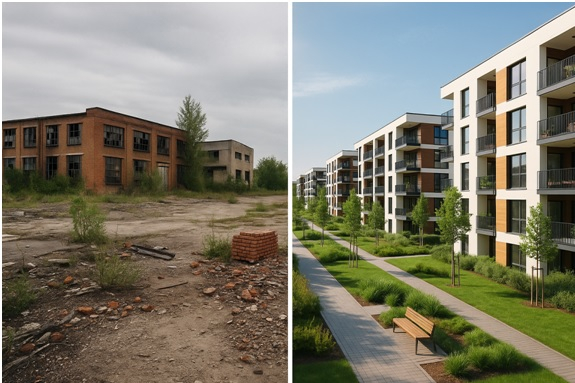
Urban living is changing fast. A new government decree has just opened the door for fresh housing developments on long-neglected industrial plots in District III and District XI of Budapest, as well as in Pécs. These “rozsdaövezeti” (rust belt) zones are set to become vibrant mixed-use neighbourhoods instead of fenced-off factory yards and empty warehouses.
For buyers, investors and renters, this is more than a planning decision. It is a signal that the housing market is slowly shifting from sprawl to smart regeneration, and that some very interesting new addresses are on the way.
What exactly is a brownfield housing project?
In simple terms, brownfield projects turn abandoned or underused industrial or military land into new residential districts, often with shops, offices and green spaces built in.
The government’s “rozsdaövezeti akcióterület” status gives these areas a special legal and planning framework so that development can move faster and more predictably.
Key aims include:
- Cleaning up polluted or visually blighted plots.
- Bringing new homes and jobs closer to existing public transport.
- Reducing the pressure to build on fresh greenfield land at the edge of towns.
Earlier waves of the program already earmarked sites in Szentgotthárd and Monor. The latest decree adds new locations in the capital and in Pécs, showing that brownfield regeneration is becoming a long-term strategy rather than a one-off experiment.
The new locations: from factory gates to front doors
According to the decree, the latest batch of rust belt housing zones covers:
- A former factory site in District III, where a residential area will be combined with retail, services and office space.
- Two adjoining plots in District XI, again ex-industrial, planned as a mix of apartments, offices and commercial functions.
- A disused former Soviet barracks complex in Pécs, earmarked for a mainly residential scheme.
- Each site comes with different timelines. Some are labelled immediate action areas, where development can start relatively soon, while others are medium to long term, allowing for more complex infrastructure and planning work.
For locals, this means that empty industrial fields and crumbling buildings could gradually turn into walkable neighbourhoods with cafés, playgrounds and new public spaces, not just blocks of flats squeezed in wherever there is room.
Why timing matters: a market short of new homes
All this is happening against a backdrop of tight housing supply.
KSH data shows that only 13,295 new homes were completed in 2024, a steep 29 percent drop compared with the previous year.
The trend continued in 2025. In the first half of the year, 5,129 new homes were finished, 15 percent fewer than in the same period of 2024. The good news is that building permits bounced back strongly, with 12,830 homes authorised, 43 percent more than a year earlier, which suggests a new wave of projects is lining up.
At the same time, prices have surged over the past decade:
- The overall housing price level in 2023 was 7.1 percent higher than in 2022.
- Within that, used homes rose by 6 percent and new homes by 15 percent.
- Compared with 2015, new build prices more than doubled, while the combined housing price index reached 273 percent of the 2015 level.
In the capital, KSH estimates show that a brand new home cost on average about 71.3 million forints in 2023, with typical prices per square metre close to 1.3 million forints, and nudging even higher in early 2024.
With fewer completions and strong demand for modern, energy-efficient homes, it is no surprise that buyers and renters alike feel squeezed.
How brownfield projects could change the game
So what difference can a handful of new rust belt zones really make?
1. More homes where people actually want to live
Because these sites sit inside existing urban areas, usually with good public transport and utilities already in place, they are ideal for higher density housing. That means more apartments in locations close to jobs, universities and services, not just on the fringe of cities.
2. A better mix of functions
Most brownfield masterplans combine housing with offices, shops, services and community facilities. That can create lively districts where daily tasks, from grabbing a coffee to dropping kids at nursery, are all within a short walk or tram ride.
3. Cleaner, safer neighbourhoods
Old industrial plots can be contaminated or full of derelict buildings. Regeneration normally includes environmental clean up, new trees and public spaces, better lighting and safer walkways, which is a win not only for future residents but also for those already living nearby.
4. Gentle pressure on prices
On their own, these projects will not make homes cheap. However, in a market where new completions have dropped by around a third in just one year, every large development helps ease the imbalance between supply and demand. Over time that can slow the pace of price growth, especially in neighbourhoods that see several major schemes.
What it means for buyers and investors
If you are planning to buy, these new brownfield areas are worth keeping on your radar.
- Expect modern, energy-efficient buildings, which can keep long-term utility bills predictable.
- Early phases often launch with slightly more attractive pricing or payment schedules to build momentum.
- Mixed use planning and upgraded public spaces can support long-term value, even if you pay a small premium at the outset.
For investors, rust belt housing zones can offer a combination of rental demand, thanks to central locations, and potential capital growth as districts upgrade. Just remember that these are multi year projects. Timelines can slip, and early marketing material is not the same as a final, built neighbourhood.
5 quick Q&As about the new rust belt housing zones
1. Which cities are getting new brownfield housing projects now?
The latest decree covers former industrial or military plots in District III, District XI and Pécs, building on earlier designations in Szentgotthárd and Monor.
2. Why is the government focusing on these sites?
The goal is to turn neglected, sometimes polluted areas into healthy residential and work environments, using existing infrastructure instead of building over fresh greenfield land.
3. How many new homes are needed overall?
Recent figures show that just over thirteen thousand homes were completed in 2024 and only a little more than five thousand in the first half of 2025, while experts estimate that tens of thousands of new units are required each year to balance demand.
4. Are prices likely to fall because of these projects?
A sharp drop is unlikely, but additional supply in well connected urban areas can help slow future price increases and give buyers more choice, especially in the new build segment.
5. What should I watch if I am interested in buying in one of these zones?
Follow planning updates, check developer track records, look closely at transport links and community facilities, and compare total costs, including utilities and maintenance, with other new build and resale options in similar locations.