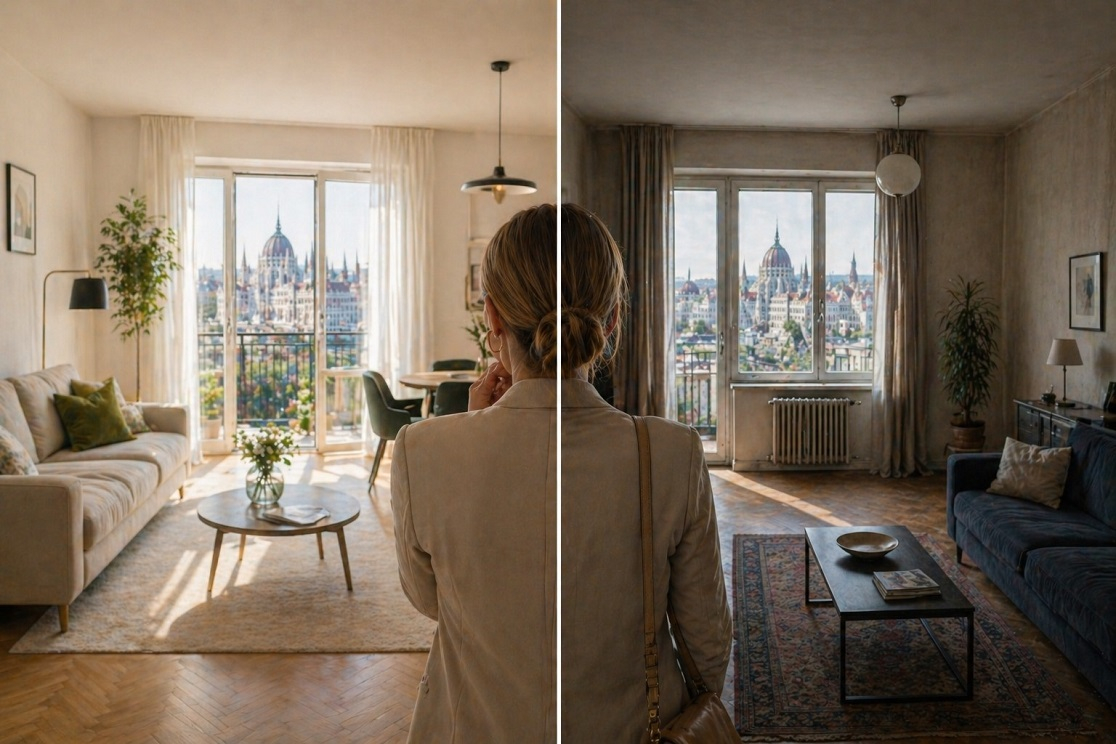
A property rented for 250,000 Ft that sits empty for one month loses roughly 8–10% of its annual income immediately. That loss is larger than most yearly rent increases, and most landlords don’t notice it at the start. If the property does not stay rented consistently, the entire return begins to break down.
Impressive monthly rent only works if it is maintained in the long term
Setting rent is not about reaching the highest possible number. If the rent is pushed too far, the property stays on the market longer and loses income instead. In practice, a slightly lower rent with continuous occupancy often produces a stronger yearly result than chasing a higher figure and accepting gaps between tenants.
Most landlords try to maximise rent, but stability is what actually drives performance. In Budapest, this becomes visible in slower periods and in districts where multiple similar apartments compete for the same tenants.
Vacancy is not neutral
Vacancy is not just a pause in income. One empty month removes revenue while costs continue, and a switched on tenant often negotiates from that position. Don’t forget vacancy also means cleaning the property once the previous tenant leaves, and often renovation and repair costs to make the property presentable to show new tenants.
For that reason, performance is not driven by peak rent in the long run, but by how consistently the property stays occupied over time.
Tenant choice changes the outcome
Two tenants paying the same rent can produce very different results. A stable tenant pays on time, stays longer, and creates fewer issues. An unstable tenant increases turnover, raises repair costs, and introduces uncertainty into the income stream.
Over time, these differences are more significant than small variations in rent. This is often where landlords underestimate the long-term impact of tenant selection.
Condition affects both rent and vacancy
Tenants compare quickly, often within minutes of seeing a listing or walking into a property. If an apartment feels outdated next to similar options, hesitation appears immediately and leads to negotiation or rejection.
Small improvements such as better lighting, fresh paint, or additional storage do more than improve appearance. They reduce hesitation during viewings, which shortens vacancy times between tenants and supports higher rental levels. In Budapest, this is particularly relevant in older buildings, where condition can vary significantly even within the same price range and/or size of property.
Most issues appear after the purchase
The real issues rarely show at the point of purchase. At that stage, the planned often ‘optimistic’ rental amount seems reasonable and the price feels aligned with the area. The problem becomes visible later, once the property is operating.
When realistic rent levels, vacancy periods, and maintenance costs are fully accounted for, the expected/’real’ return often changes. This is typically where properties that look acceptable on paper begin to underperform in practice.
Why this matters more now than ever before in Budapest
The relationship between prices and rents has shifted. Purchase prices have increased much faster than rental levels over the last 12 months, while financing costs have also increased, leaving less margin for error in each purchase decision.
In this environment, small miscalculations are no longer absorbed by the market. They show up directly in your end of year return. A few weeks of vacancy or slightly optimistic rent assumptions can materially change the outcome.
Understanding how similar apartments actually perform, how quickly they rent, what tenants expect, and what the real costs look like, becomes critical. These are the areas most landlords misjudge without consistent exposure to the market.
A simple way to look at it
Rental performance is driven by a small number of factors working together: rent level, occupancy, tenant stability, and ongoing costs. If one of these weakens, the return drops immediately.
Final thought
A property does not perform because the rent looks good on paper prior to purchase. It performs when the rent holds, the tenant stays long term, the property is well maintained, and the numbers continue to work in your favour month after month. That is where most investment properties fail and where the difference between ‘successful’ and ‘not successful’ property investing often lies.