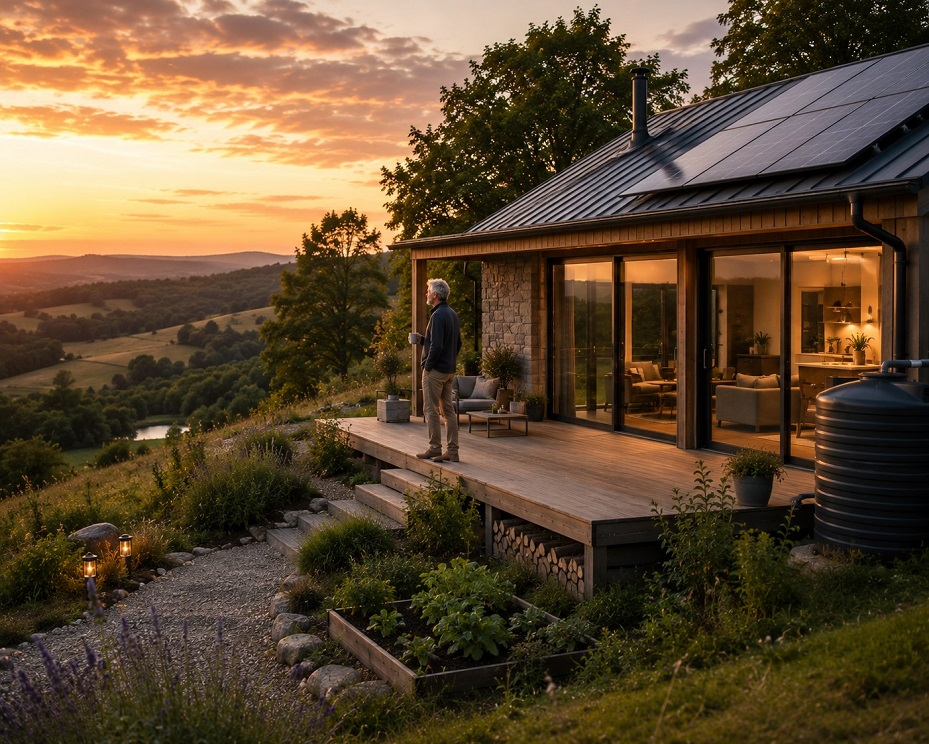
A modern off-grid home may look exactly like any other contemporary house. It might have floor-to-ceiling windows, a spacious kitchen, underfloor heating and a comfortable living room overlooking the countryside. The difference is that there may be no utility connections running to it at all.
Electricity comes from solar panels and batteries. Water comes from a private well or rainwater-harvesting system. Wastewater is treated on-site. What was once associated with remote cabins and self-sufficient homesteads is increasingly becoming a realistic option for homeowners looking for a different way of living.
Modern Off-Grid Homes Look Different Than Many People Expect
The image of off-grid living has changed significantly over the past decade.
Advances in prefabricated construction, battery storage and renewable energy systems mean many off-grid homes now offer the same level of comfort people expect from conventional houses. Rather than building remote cabins from scratch, many projects start with highly insulated prefab or modular homes designed to minimise energy consumption from the beginning.
A turnkey prefabricated home in Hungary typically costs between approximately HUF 430,000 to HUF 700,000 per square metre. Standard 40-50 square metre modular homes are available from around HUF 18 million to HUF 21 million plus VAT.
"Most people still imagine off-grid living as something quite extreme," said Alex Markus, Chief Executive of City-Lets Ltd.
"In reality, many modern off-grid homes look very similar to conventional homes. The difference is usually hidden behind the walls and beneath the ground."
The Lifestyle Is Simple. The Infrastructure Is Not
One of the reasons off-grid living appeals to some homeowners is its simplicity.
However, creating that simplicity requires substantial infrastructure. A modern off-grid property may include solar panels, battery storage, a backup generator, a drilled well, water filtration equipment and a biological wastewater treatment system. These are services most connected homes receive automatically through public infrastructure.
For some rural properties, the decision is not simply about independence. Extending electricity, water or sewer connections across a large site can be expensive, and in some locations the required infrastructure may not be immediately available. In those situations, an off-grid system may become part of the economic calculation rather than purely a lifestyle choice.
The largest investment is often the energy system. A year-round off-grid solar installation with 8-12 kWp of solar generation and 15-20 kWh of lithium battery storage typically costs between HUF 4 million and HUF 6.5 million. Larger systems capable of supporting heat pumps, electric vehicles and higher energy consumption can exceed HUF 10 million.
Many homeowners also install backup generators costing between HUF 550,000 and HUF 1.8 million to provide additional security during winter.
Water Independence Comes With Its Own Costs
Most off-grid homes need their own source of water. That usually means drilling a well, installing pumps and adding filtration equipment capable of supplying the household throughout the year.
In Hungary, a residential well typically costs between HUF 1.2 million and HUF 2.5 million once permits, pumps and installation are included. Water filtration and purification systems can add another HUF 300,000 to HUF 800,000.
Some homeowners go further by incorporating large rainwater-harvesting systems. A 100,000-litre installation typically costs between HUF 4.5 million and HUF 7.5 million once underground storage tanks, excavation and filtration systems are included.
The goal is not simply to collect water. It is to create a reliable year-round supply that can support everyday living.
Wastewater Also Needs a Plan
Wastewater is one of the least visible parts of an off-grid home, but it is essential.
Modern off-grid homes increasingly rely on biological wastewater treatment systems rather than simple holding tanks. These systems process wastewater on-site before returning it safely to the surrounding environment.
Installation typically costs between HUF 1.5 million and HUF 2.5 million for a standard residential system, although larger or more complex sites can cost more depending on ground conditions and local requirements.
Government Support Can Change the Numbers
For some rural properties, government support can significantly reduce the cost of going off-grid.
Certain properties registered as tanya may qualify for specialised rural-development programmes supporting renewable energy, water supply and wastewater infrastructure. For eligible projects, available support can reach up to HUF 25 million.
"The interesting thing is that many people are not trying to disconnect from modern life," Markus said.
"They are often looking for a home that gives them more control over how it functions day to day. The goal is usually reliability and independence rather than isolation."
A Different Approach to Home Ownership
Off-grid living remains a niche choice, and it requires significantly more planning than a conventional home.
Yet modern construction methods and energy systems are making it increasingly achievable for homeowners willing to invest in the infrastructure behind it.
What makes the trend interesting is not that people are abandoning modern comforts. In many cases, they are keeping those comforts while changing where the electricity, water and services come from.
Off-grid living was once associated with compromise. Increasingly, it is becoming another way of building a modern home.